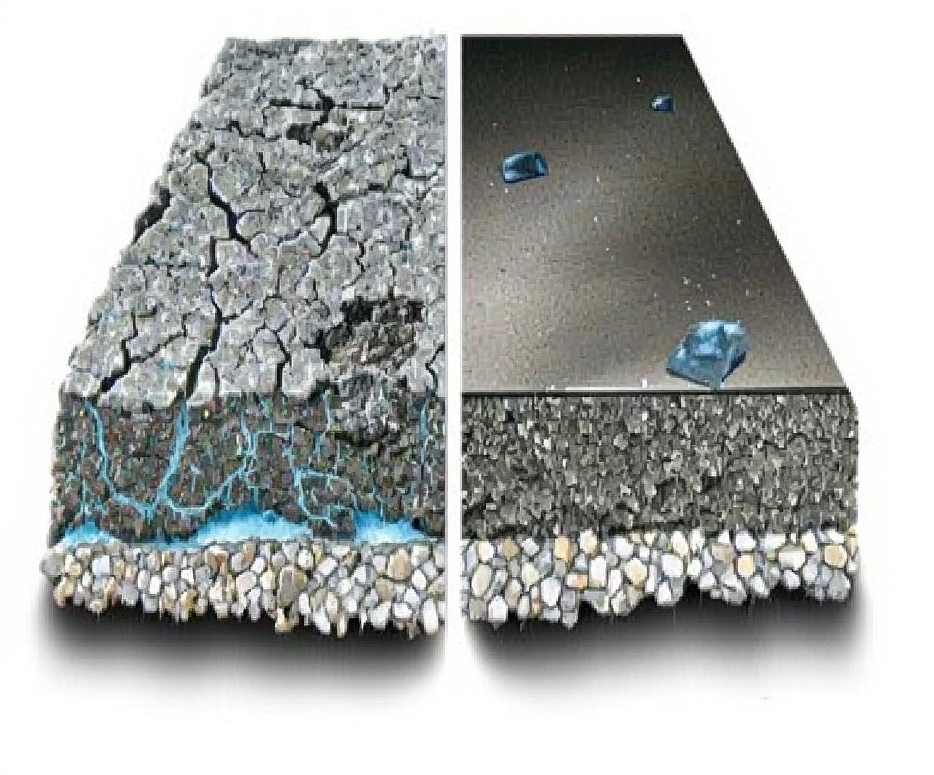
Scientific research has proven the benefits of using Gilsonite in asphalt pavement. Studies conducted in 2015 by the Western Regional Superpave Center at the University of Nevada's College of Civil and Environmental Engineering in Reno have proven that the use of Gilsonite-modified binders significantly increases the service life of asphalt pavement. This is good news for organizations looking to reduce the long-term costs of asphalt pavement repair and maintenance.
)
)
( Asphalt containing Gilsonite )
Findings from comprehensive tests have shown that the use of Gilsonite-modified binders leads to a significant improvement in the following:
- Tensile Strength: Adding Gilsonite significantly increased tensile strength in wet and normal conditions.
- Compressive Strength: The use of Gilsonite-modified binders has led to a significant improvement in compressive strength.
- Rutting Resistance: The use of Gilsonite-modified binders has led to a significant increase in the predicted life of the pavement. In all but one case, adding Gilsonite resulted in a 10-fold increase in pavement life.
- Fatigue Resistance: The predicted life of the pavement is 1.5 to 5 times longer when using Gilsonite-modified binders.
Reduces the amount of materials needed and saves costs
Gilsonite increases the viscosity of asphalt, thus, unlike other modifying agents or high modulus asphalts based on RAP, it makes roads resistant to deformation and fatigue even at high temperatures. There are many industry reports of Gilsonite-modified asphalt lasting more than twice as long as unmodified mixtures. In addition, the high modulus achieved by using Gilsonite allows the base and binder layers to be up to 20% thinner, while providing the same level of performance, which enables us to use less material. Gilsonite can also act as a cheaper and higher-performing extender in a mixture containing SBS polymers. By significantly increasing the service life of asphalt pavement and enabling a reduction in the amount of pavement materials required, Gilsonite has proven to be significantly cost-effective.
)
Gilsonite is the best in asphalt recycling
Only Gilsonite-modified binder bonds to and stabilizes the recycled binder, making recycled asphalt as strong and durable as new asphalt. In contrast, polymer-modified binders form large molecules that cross-link into a matrix to which the recycled binder cannot bond, making the pavement susceptible to cracking.
)
( Recycled without Gilsonite) ( Recycled with Gilsonite)
Gilsonite-modified binder spreads within the RAP binder while modifying it.
Polymer-modified binder with cross-linking is not spreadable and leaves the RAP binder unmodified.
No other additive can have all the benefits of Gilsonite:
- High strength and fatigue resistance
- Reduced temperature sensitivity
- High resistance to deformation
- Increased resistance to abrasion (scouring)
- Reduced pavement thickness
- Safety and environmental responsibility
Gilsonite performance is proven
Gilsonite's unique properties make the road built less sensitive to high temperatures and deformation. Gilsonite can be added directly to the hot mix plant without additional equipment.
Gilsonite strengthens roads
To have a road that lasts longer than a normal road that may last 10 years, Gilsonite produces a stronger asphalt with better bonding that can last 25 years.
Using Gilsonite as a cost-effective component of polymer modified
Polymer-modified additives can improve binder performance under certain difficult conditions. However, the cost of SBS polymers is more than twice that of Gilsonite. A more cost-effective solution is to combine Gilsonite with SBS polymers to achieve the desired grade.
Asphalt containing Gilsonite is resistant to rutting
Gilsonite increases the viscosity of asphalt, thus, unlike other modifying agents or high modulus asphalts based on RAP, it makes roads resistant to deformation and fatigue even at high temperatures.
Gilsonite performs better than other bitumen modifiers
- Unique source with high purity deposits
- Low pollution extraction
- Ideal softening point for bitumen modification
- Natural antioxidant properties that resist hardening and degradation over time
Building stronger roads for over 100 years
Gilsonite is the trade name of natural asphalt discovered in the Uinta Basin in northeastern Utah. Since the 1860s, the We Gilsonite Company has been producing Gilsonite to strengthen asphalt roads. Gilsonite is readily available in meltable bags.
Gilsonite is versatile and cost-effective, adding a new dimension of strength to asphalt. Gilsonite is a natural hydrocarbon resin that gives asphalt roads exceptional strength, durability, and longevity. Gilsonite is a cost-effective additive with unparalleled performance.
Evaluation of Gilsonite-modified asphalt mixture
Gilsonite, a cost-effective additive that increases strength, reduces rutting and cracking, has been used as an additive to improve the performance of asphalt pavements for over 100 years. While field experience has shown the benefits of using Gilsonite, the unique properties of Gilsonite-modified asphalt have not been well demonstrated due to the lack of a comprehensive evaluation.
However, a study conducted in 2015 by the Western Regional Superpave Center at the University of Nevada's College of Civil and Environmental Engineering in Reno fully analyzed various asphalt pavements using the latest advances in materials testing, pavement modeling, and life cycle analysis.
Key research points
This evaluation was performed under strict standards:
- An independent supplier prepared control samples and Gilsonite-modified versions with two different asphalt performance grades (PG): PG64-28, which represents the designed performance for the pavement temperature range between minus 28 degrees Celsius and 64 degrees Celsius, and PG76-16, which is designed for the pavement temperature range between minus 16 and 76 degrees Celsius.
- All asphalt binders were compliant with applicable state highway specifications based on the Superpave PG system for asphalt binders.
- The optimum binder content (OBC) of each asphalt mixture was determined through the Superpave volumetric mix design method.
- Laboratory equipment included the Asphalt Mixture Performance Tester (AMPT).
- The engineering properties of the asphalt mixtures were measured at their optimum binder content and in terms of the dynamic modulus master curve E*.
- The following performance characteristics were evaluated for the asphalt mixtures:
- Rutting resistance in terms of flow number
- Resistance to thermal cracking in terms of fracture temperature and fracture stress
- Fatigue cracking resistance in bending
Quantifying Performance
Gilsonite has long been used to enhance the performance of asphalt binders. Now the study addresses its benefits.
Superpave PG properties used in the test
)
The Superpave Performance Grading (PG) system uses the rheological properties of asphalt binder to determine its performance in the prevailing environmental conditions at the project site. The properties of the binders used in the test are summarized in the table below.
A close examination of the data shows that adding Gilsonite to the PG 76-16 mixture results in an asphalt binder with less sensitivity to short-term and long-term aging.
Industry Standard
The Superpave Performance Grading (PG) system includes asphalt binder specifications that are commonly used in the United States.
Significant increase in strength with similar binder content
The Superpave system determines the optimum binder content (OBC) based on a 4% air void level while maintaining the specified bulk properties. Tests have shown that OBC was comparable with controlled and Gilsonite-modified samples. PG 64-28 mixtures required the addition of hydrated lime to achieve moisture sensitivity characteristics. Gilsonite-modified binders showed a significant improvement in tensile strength (TS) and unconfined compressive strength (UCS).
A summary of the optimum binder content and lime content, tensile strength properties under wet and normal conditions, and unconfined compressive strength of different mixtures is presented in the table below.
| PG76-16 Control | PG76-16 Gilsonite | PG64-28 Control | PG64-28 Gilsonite |
Optimum Binder Content (%) of Total Mix Weight | 5.20 | 5.10 | 4.50 | 4.50 |
Air Voids at Optimum Binder Content (%) | 4.0 | 3.9 | 4.2 | 4.2 |
Lime Content (%), Dry Weight | No Lime | No Lime | 1.00 | 1.00 |
TS in Normal Conditions 77° F, psi | 168 | 265 | 115 | 126 |
TS under Specific Conditions 77° F, psi | 102 | 154 | 95 | 113 |
UCS in Normal Conditions 77° F, psi | 734 | 909 |
|
|
UCS under Specific Conditions 77° F, ps UCSi | 448 | 573 |
|
|
Dynamic Modulus (E*) Represents Resistance and Stability
The American Association of State Highway and Transportation Officials (AASHTO) mechanistic-empirical design uses the dynamic modulus master curve as an engineering property of the asphalt concrete layer to evaluate the structural response of asphalt pavement under different combinations of traffic load, speed, and environmental conditions.
Higher E* indicates a more resistant and stable mixture and results in lower stresses in the asphalt pavement under specified environmental and loading conditions. The master curve data in the figure below shows that Gilsonite mixtures show significantly higher E* properties than control mixtures across the loading frequency spectrum.
)
Recording a Spectrum of Variables
The dynamic modulus curve shows different combinations of loading frequency and temperature.
The data in the graphs below compares the E* property of the mixtures at a loading frequency of 10 Hz, which is equivalent to the movement of a truck at a speed of 60 miles per hour (108 kilometers per hour). Temperatures of 104 degrees Fahrenheit (40 degrees Celsius) and 70 degrees Fahrenheit (21 degrees Celsius) were chosen because they represent the critical temperatures of rutting and fatigue, respectively.
Right figure: Gilsonite; Dynamic modulus properties for rutting analysis (short-term aging)
Left figure: Control; Dynamic modulus properties for fatigue analysis (long-term aging)
Gilsonite Helps Reduce Rutting
Gilsonite increases the viscosity of asphalt and thus makes the road resistant to fatigue and deformation even at high temperatures.
Resistance to Rutting
The flow number property was evaluated to investigate the resistance of mixtures to rutting and to determine the coefficients of the rutting model. The figure below compares the rutting models of the mixtures. The PG 28-64 mixture modified by Gilsonite showed a lower rutting model at 104 degrees Fahrenheit (40 degrees Celsius) than the control mixture, indicating that the Gilsonite mixture provides more resistance to rutting. The rutting model of the Gilsonite PG 76-16 modified mixture was slightly higher than the control mixture at 104 degrees Fahrenheit (40 degrees Celsius).
)
As can be seen below, adding Gilsonite to the PG 76-16 mixture increased the flow number by 66 percent at 60 degrees Celsius (140 degrees Fahrenheit) (from 454 to 754). Adding Gilsonite to the PG 64-28 mixture resulted in resistance to tertiary flow at 48 degrees Celsius (118 degrees Fahrenheit). This indicates that Gilsonite-modified mixtures show more resistance to rutting at high pavement temperatures.
Flow number for PG 76-16 and PG 64-28 mixtures
)
Preparation of the Relevant Sample
Since rutting is a failure that occurs early in the life of the pavement, the mixtures required for the flow number test only had short-term aging.
Resistance to Thermal Cracking
To determine the ability of a specific asphalt mixture to resist cracking at low temperatures, the tests measured the temperature at which the fracture occurred as well as the stress required to create the initial fractures.
In the PG 64-28 samples, both the control binder and the Gilsonite-modified binder passed the low temperature (cold) specifications, and therefore no cracking was expected for them.
The Gilsonite PG 76-16 modified sample showed cracking at a temperature 2 degrees Celsius warmer than the specifications. However, the calculated crack initiation energy was 20% higher than the control sample, so it was not expected to crack under normal conditions.
Thermal Cracking Properties of Evaluated Mixtures
Mixture | PG76-16 | PG76-16 | PG64-28 | PG64-28 |
| Control | Gilsonite | Control | Gilsonite |
Average Air Voids (%) | 6/9 | 7/1 | 6/2 | 7/1 |
Average Fracture Temperature (C) | –19 | –14 | –35 | –30 |
Average Fracture Stress (psi) | 340 | 335 | 550 | 420 |
Crack Initiation Energy (Pa/mm/mm) | 322 | 387 |
|
|
Fatigue Cracking Resistance
The fatigue cracking resistance of the various mixtures was investigated using a bending beam test in which a beam sample was placed under a constant bending moment at the center of the sample. The initial flexural stiffness was measured at the 50th load cycle. Fatigue failure was defined as the number of cycles corresponding to a 50% reduction in the initial stiffness.
The figures below compare the fatigue models for the mixtures. The cycle-to-failure tests showed comparable results for the PG 76-16 control and Gilsonite samples. In the PG 64-28 mixtures, the control sample showed relatively higher fatigue relationships than the Gilsonite mixture. It is worth noting that the calculated values for the effect of much higher E*s in the Gilsonite-modified binder are not considered.
Fatigue cracking models for PG 76-16 and PG 64-28 mixtures at 70 degrees Fahrenheit tested at the appropriate time
Thermal cracking and fatigue cracking are failures related to the late life of the pavement, which usually occur after five years. The aging of the tested mixtures was carried out accordingly.
Mechanistic Analysis Examines Real Conditions
In addition to advanced laboratory testing, the university evaluation also included mechanistic analysis. A laboratory experiment was designed to compare the fatigue cracking models of two asphalt mixtures, which only examines the relative behavior of the mixtures without any indication of their relative effects on pavement life.
The main advantage of mechanistic analysis is its ability to combine the engineering properties of the asphalt mixture (E*) with its rutting and fatigue cracking properties to determine the actual impact of traffic loads on pavement life. In this analysis, thin pavements (asphalt cement layer (composite shell) AC) smaller than 4 inches and 8-inch gravel base layer (CAB)) and thick pavements (6-inch AC layer and 12-inch CAB layer) were evaluated. The dynamic conditions include the heavy load applied by an 18-wheel trailer with a legal load moving at 60 miles per hour (96 kilometers per hour) without braking and at 10 miles per hour (16 kilometers per hour) with braking.
Mechanistic analysis of rutting resistance showed that in all but one case, the pavement life of Gilsonite-modified mixtures was 10 times greater than the predicted life. In the case of fatigue resistance, the predicted pavement life of Gilsonite-modified mixtures was 1.5 to nearly 5 times the predicted life of the control mixture.
In Theory and in Practice
Mechanistic analysis completes the picture that began with laboratory testing.
Vertical and horizontal forces affecting pavement life
When an 18-wheel trailer is under freewheeling conditions (driving without braking), the vertical loads are evenly distributed across the different axles. During braking, the vertical loads are redistributed on the axles and significant horizontal loads are generated on the tire/pavement interface. These horizontal loads significantly increase the shear and vertical stresses in the AC layer and are the main cause of severe failures in rutting and raveling at intersections and exit ramps.
)
Findings from mechanistic analysis:
- The PG 64-28 control mixture cannot be designed to adequately resist the braking action of an 18-wheel trailer in both thin and thick pavement structures.
- PG 64-28 and PG 76-16 mixtures modified with Gilsonite significantly improved the rutting life of thin and thick pavements under non-braking and braking conditions.
- The Gilsonite PG 76-16 mixture significantly improved the fatigue life of thin pavement under non-braking and braking conditions.
Load Bearing
Mechanistic analysis shows which mixtures significantly improved road life.
Specific Results and Recommendations
In summary, the evaluation program concluded that adding Gilsonite to asphalt binders modified with pure PG 76-16 and polymeric PG 64-28 resulted in unique and measurable properties that provide excellent alternatives in the following situations:
- The PG 76-16 mixture provides very high resistance to rutting and raveling with very good long-term aging properties for use in the asphalt pavement surface layer.
- Both PG 76-16 and PG64-28 mixtures provide very high resistance to fatigue cracking, which is useful for use as a binder/base layer of durable asphalt pavements.
- The PG64-28 mixture can withstand the braking action behind red lights on urban streets and exit ramps.
Cost-Effectiveness
Adding Gilsonite can significantly increase the service life of asphalt pavement by adding properties that increase resistance to rutting, raveling, and fatigue cracking. Industry reports of Gilsonite-modified asphalts lasting more than twice as long as unmodified mixtures are abundant.
In addition, the high modulus resulting from the addition of Gilsonite allows the base and binder layers to be up to twenty percent thinner, while providing the same level of performance, which enables us to use less material.
Gilsonite can also act as a cheaper and higher-performing extender in a mixture containing SBS polymers.
By significantly increasing the service life of asphalt pavement and enabling a reduction in the amount of pavement materials required, Gilsonite has proven to be significantly cost-effective.
Use of Gilsonite in Road Asphalt
Gilsonite (natural bitumen) is a natural hydrocarbon material characterized by a high softening point (above 110 degrees Celsius) in the asphaltite group. These materials are extracted very similarly to other minerals and are mainly sold in the same country. These materials are completely compatible with asphalt and have long been known as asphalt hardeners and reinforcing materials. Gilsonite is currently sold worldwide as a road bitumen modifier and in dry solid granular powder form.
The mixture of Gilsonite (natural bitumen) with road asphalt relates to a base compound that is a combination of natural bitumen and rubber latex residues. The base can be used alone as a pavement material or in an emulsion with natural bitumen, which has many uses. The natural bitumen mixture makes asphalt resistant to rutting and reduces the thickness of the asphalt.
This invention resulted in an asphalt cement composition consisting of petroleum asphalt, natural bitumen, reactive oil, and an elastomer. The elastomer has a gel content of up to about 95% by weight.
Road asphalt modified with Gilsonite (natural bitumen) has been particularly successful in areas with very high traffic. Natural bitumen, as the largest component of the mixture, is combined with virgin polymers such as styrene-butadiene-styrene (SBS) and ethyl vinyl acetate (EVA). Gilsonite-modified asphalt binders typically do not increase the amount of asphalt binder required in pavement mixtures.
The performance grading of asphalt binders and pavement mixtures became a reality through the FHWA $50 million Strategic Highway Research Program "SHRP" in March 1993. "SHRP" has developed new asphalt binder specifications and testing criteria based on engineering properties related to pavement performance.
Today, the importance of asphalt is obvious to everyone around the world due to its use in road networks, airports, highways, etc.
The use of asphalt with appropriate quality is important in various aspects:
Economic aspect: A significant portion of the budget of municipalities, urban development and construction, engineering, road construction and transportation sectors is spent on the production, implementation and maintenance of asphalt. If it is possible to produce asphalt with two to three times longer effective life, the costs related to asphalt repair and maintenance will decrease accordingly. It is also clear that if cheaper materials can be used as modifiers or bitumen for asphalt, the cost will be reduced.
Environmental aspect: The bitumen in asphalt pollutes the environment, especially groundwater, due to the presence of heavy aromatic substances that may enter the environment in small amounts after rainfall. By replacing a small percentage of bitumen with green materials such as Gilsonite (natural bitumen) or using complexing materials, this pollution can be reduced.
Driving aspect: It is obvious that good asphalt affects driving. Today, good quality asphalt with low sensitivity to deformation, low temperature sensitivity, high abrasion resistance and high friction rate will help driving safety at high speeds and in different weather conditions (cold, hot, freezing).
Aspect of preserving minerals and natural resources: In the production of asphalt, stone materials are also used along with bitumen and other additives. By increasing the effective life of asphalt, the amount of use of these materials will also decrease. In developed countries, in order to increase the stiffness and life of asphalt and achieve the mentioned goals, different mixtures such as PPA, EVA and SBS are used as modifiers and fillers. These materials are expensive and toxic. Therefore, producing a modified asphalt with lower production cost, lower toxicity and equal or better quality is one of the goals of researchers in the field of asphalt.
During the past decade in Iran, asphalt modifiers have not been used due to their high price. This has led to a significant reduction in the quality of asphalt and its effective life, so that the life of Iranian asphalt is one-third